
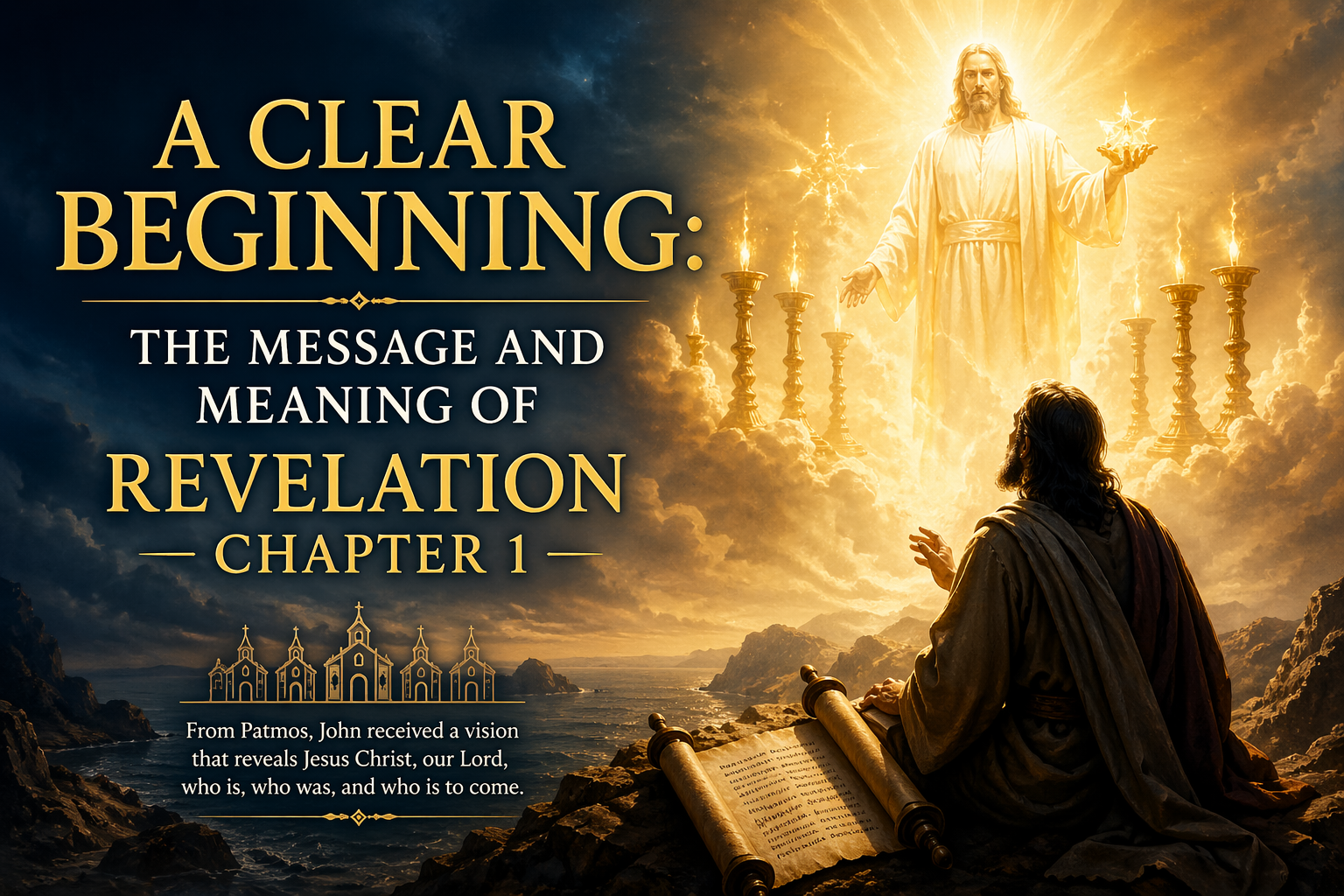
The first chapter of the Book of Revelation opens in a powerful yet meaningful way. It introduces readers to a message that is not meant to confuse or frighten, but to reveal truth, give hope, and show authority about A Clear Beginning. This chapter serves as a doorway into a larger vision, helping us understand that what follows comes from a divine source and carries deep importance for anyone willing to listen.
A clear beginning, it is clearly stated that this message comes from Jesus Christ.
At the very beginning, it is clearly stated that this message comes from Jesus Christ. This is important because it tells us that the words are not simply human thoughts or imagination. Instead, they are given with purpose, meant to uncover things that were previously hidden. The idea of “revelation” itself means something being made known or brought into the light. So right away, readers are invited to see this as a message of clarity rather than confusion.
The chapter also highlights that there is a blessing connected to this message. Those who read it, hear it, and take it seriously are promised something good. This shows that the book is not just for study, but for personal reflection and application. It is meant to affect how people think and live, not just what they know.
John then sends greetings to seven churches, offering them grace and peace. These two words carry deep meaning. Grace speaks of kindness that is not earned, while peace reflects a sense of calm and stability within. Together, they show what God provides even in difficult situations. John connects this greeting to the eternal nature of God, describing Him as the one who exists across all time, past A Clear Beginning, present, and future. This reminds readers that God is steady and unchanging, no matter what is happening in the world.
The focus then turns to Jesus Christ, who is described using several important titles. He is called the faithful witness, meaning He represents truth without error. He is also described as the first to rise from the dead, showing victory over death. In addition, He is presented as having authority over all rulers on earth. These descriptions are meant to help readers understand His power, reliability, and role in the bigger picture.
There is also a personal and comforting message included here. It speaks about how Jesus loves people and has freed them from sin. This is not just a general statement, but something that individuals can hold onto personally. It also explains that believers are given a special role, being described as a kingdom and as priests. This means they are given purpose and a direct connection to God.
One of the most striking ideas in this chapter is the promise of Jesus returning. It describes Him coming with the clouds, visible to everyone. This is not a hidden event, but something that all people will witness. It points to a future moment where truth and authority will be fully revealed. This also reminds readers that life is moving toward a meaningful conclusion, not just random events.
John then shares his own situation, explaining that he is on the island of Patmos because of his faith. This detail adds depth to the message. He is not writing from a place of comfort, but from a position of difficulty and isolation. Despite this, he remains committed and faithful. This shows that strong faith can exist even during hardship, and it makes his message more powerful and real.
A Clear Beginning when John hears a loud voice, strong and attention-grabbing, like a trumpet. He is told to write down what he sees and send it to the churches. When he turns to see who is speaking, he experiences a powerful and symbolic vision of Jesus.
In this vision, Jesus is standing among seven golden lampstands, which represent the churches. This shows that He is present among His people and aware of their situation. His appearance is described in a way that reflects authority, wisdom, and purity. His eyes are compared to fire, suggesting that nothing is hidden from Him. His voice is described as powerful, like rushing water, showing strength and command.
He holds seven stars in His hand, representing leaders connected to the churches. This shows that He has control and care over them. A sharp sword is described as coming from His mouth, symbolizing the strength and truth of His words. His face shines brightly, reflecting glory and holiness.
The experience is overwhelming for John, and he falls to the ground in fear. This reaction shows the natural human response when faced with something so powerful and divine. However, what happens next is equally important. Jesus reaches out to him and tells him not to be afraid. This moment shows both strength and kindness together. It reminds readers that while God is powerful, He is also compassionate and caring.
Jesus then speaks about who He is, declaring that He is eternal and alive forever. He explains that He once died but has now overcome death completely. He also states that He has authority over death and what comes after, showing complete control over life’s greatest mystery.
John is then given a clear instruction. He is told to write about what he has seen, what is happening now, and what will happen in the future. This gives structure to the entire message of Revelation. It is not only about future events, but also about understanding the present in light of God’s plan.
The chapter closes by explaining part of the vision A Clear Beginning. The stars and lampstands are given clear meaning, helping readers understand that the symbols are not random. They carry specific messages that can be understood with guidance.
Overall, Revelation chapter 1 is a strong and meaningful introduction. It is not meant to create fear, but to build confidence and understanding. It reminds readers that God is in control, that Jesus has power over death, and that He is present with His people. It also encourages faithfulness, even when life becomes difficult.
This chapter invites readers to pay attention, reflect deeply, and remain steady in their beliefs. It sets the stage for everything that follows, offering a foundation of hope, truth, and purpose and A Clear Beginning.
A Clear Beginning: Understanding Creation Through the Bible
The idea of a clear beginning is foundational to the message of the Bible. It speaks not only to how the world came into existence, but also to purpose, identity, and the nature of God. The opening words of Scripture provide one of the most powerful and profound statements ever written: “In the beginning, God created the heavens and the earth” (Genesis 1:1). With this simple yet majestic declaration, the Bible establishes that everything starts with God. He is the source, the designer, and the sustainer of all life.
The Meaning of “Beginning”
The Bible does not begin with an argument for God’s existence. Instead, it assumes it. The phrase “in the beginning” marks the start of time itself. Before this moment, there was no creation, no universe, no human history, only God. This tells us something important. God exists outside of time. He is eternal, uncreated, and independent of anything else.
A clear beginning helps us understand that life is not random or accidental. The world did not come into being by chance, but by intentional design. This gives meaning to existence. If there is a beginning designed by God, then there is also purpose behind everything that follows.
God as Creator
In Genesis 1, God creates the world through His word. He speaks, and creation comes into existence. “Let there be light,” and there was light. This pattern repeats throughout the chapter, showing the authority and power of God. Unlike human creators who need materials and tools, God creates from nothing.
Each stage of creation reveals order and structure. Light is separated from darkness, land from sea, and day from night. Plants, animals, and finally humans are created in a sequence that reflects purpose and intentionality. After each act, God declares that it is good. This repeated affirmation emphasizes that creation is not flawed or accidental. It is good because it comes from a good God.
Humanity’s Unique Beginning
Among all of creation, humanity holds a special place. Genesis 1:27 states that humans are created in the image of God. This sets people apart from all other living beings. To be made in God’s image means we reflect aspects of His character, such as the ability to think, create, love, and make moral choices.
This truth gives every person inherent value and dignity. A clear beginning rooted in God means that human life is not meaningless. Every individual is intentionally created and deeply valued by the Creator.
The Order and Purpose of Creation
The structure of the creation account reveals more than just a timeline. It shows purpose. Each day builds upon the previous one, forming a world that is both functional and beautiful. Light prepares for life. Land and vegetation provide sustenance. The sun, moon, and stars mark time. Animals fill the earth, sky, and sea.
When humans are finally created, everything is ready for them. This demonstrates God’s care and provision. Humanity is not an afterthought. The world is prepared specifically for human life.
God also gives humans responsibility. In Genesis 1:28, He instructs them to be fruitful and multiply and to have dominion over the earth. This is not a command to exploit creation, but to steward it wisely. A clear beginning includes a clear calling. Humans are to care for what God has made.
The Spiritual Significance of the Beginning
The beginning described in the Bible is not just physical. It is deeply spiritual. It reveals God’s nature. He is powerful, creative, orderly, and good. It also reveals humanity’s relationship with Him. Humans are created to live in connection with God, to walk with Him, and to reflect His character in the world.
The Garden of Eden represents this perfect relationship. It is a place of peace, provision, and presence. God walks with Adam and Eve, showing that the original design of creation included close fellowship between God and humanity.
This helps us understand that the beginning was not only about creation. It was about a relationship.
The Impact of a Clear Beginning on Faith
Believing in a clear, God-centered beginning shapes how we see everything else. It influences our understanding of identity, morality, and purpose. If God is the Creator, then He has authority over creation. His design defines what is right and good.
It also provides a foundation for faith. The same God who created the world is the one who sustains it. He is not distant or uninvolved, but active and present. Throughout the Bible, God continues to work within His creation, guiding history and revealing Himself to humanity.
A clear beginning reminds believers that nothing is outside of God’s control. Just as He brought order out of chaos in Genesis, He can bring purpose and direction into our lives today.
A Beginning That Points Forward
While Genesis describes the start of creation, it also points forward to the rest of the Bible’s story. The beginning sets the stage for everything that follows. Human choices, the entrance of sin, and ultimately God’s plan for redemption.
The clarity of the beginning helps us understand the need for restoration. If the world was created good, then the brokenness we see today is not part of God’s original design. This gives hope, because it means God is working to restore what was lost.
In the New Testament, this idea is echoed in a powerful way. The Gospel of John begins with the words, “In the beginning was the Word.” This connects Jesus to creation itself, showing that He was present from the start. Just as God created the world through His word in Genesis, He brings new life and restoration through Jesus.
Conclusion
A clear beginning is more than a description of how the world started. It is a foundation for understanding life itself. The Bible presents a beginning that is intentional, purposeful, and rooted in the character of God. It tells us that we are not here by accident, but by design.
This beginning reveals who God is, who we are, and why we exist. It calls us to recognize God as Creator, to value the life He has given, and to live in relationship with Him. In a world that often feels uncertain, the clarity of this beginning offers stability, meaning, and hope.
By returning to the truth of Genesis, we are reminded that every story has a starting point, and ours begins with God.